Codium Logo Codium Logo
  • Services
  • Industries
  • Our Work
  • About
  • Blog
Our work · Case study

Country SA PHN

Country SA PHN commissions primary mental health and alcohol and other drug services across regional and rural South Australia, and every commissioned service has to report its episodes of care into the national Minimum Data Set. Codium built a multi-tenant MDS portal where those services record clients, intakes, episodes of care, service contacts and clinical outcome measures in one compliant system, with Statistical Linkage Keys generated automatically.

Cloud applicationHealthClinical dataMinimum Data SetMulti-tenant
Visit countrysaphn.com.au
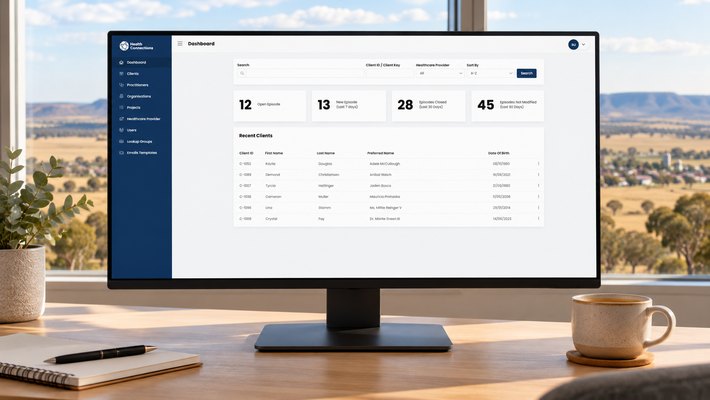
Country SA PHN MDS portal dashboard on a monitor in a regional office with wheat paddocks outside
  • ClientCountry SA Primary Health Network
  • IndustryHealthcare and public health, regional South Australia
  • The workA multi-tenant Minimum Data Set portal for PMHC and AOD episodes of care with clinical tool inputs.
  • CompliancePMHC MDS and AOD reporting with automated Statistical Linkage Key (SLK) generation.
The brief

Compliant clinical data collection, shared by every commissioned service

Services commissioned by the PHN were each collecting MDS data their own way, and the PHN was assembling the reporting from what came back. The portal gives every service a tenant of its own, with the PHN seeing across all of them. Each client is recorded once, with their intake, every episode of care, the service contacts within it and the clinical outcome measures collected along the way, captured in the structure the Minimum Data Set expects. Codium ran discovery with the PHN and its providers, prototyped the admin and provider interfaces, and delivered the portal as the first stage of a wider platform.

01

Multi-tenant by design

Each healthcare provider works in its own tenant with its own teams, practitioners and clients, while PHN staff see and report across all of them.

02

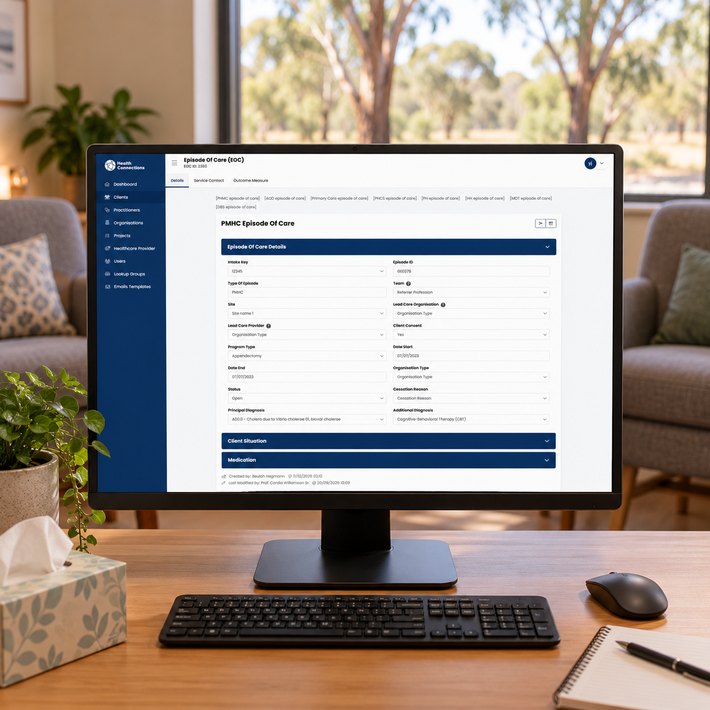
PMHC episodes of care

Primary Mental Health Care episodes with diagnosis, program type, lead care organisation and provider, client situation and medication sections.

03

AOD episodes of care

Alcohol and Other Drugs episodes with overview, drugs of concern and treatment type sections, alongside the shared episode details.

04

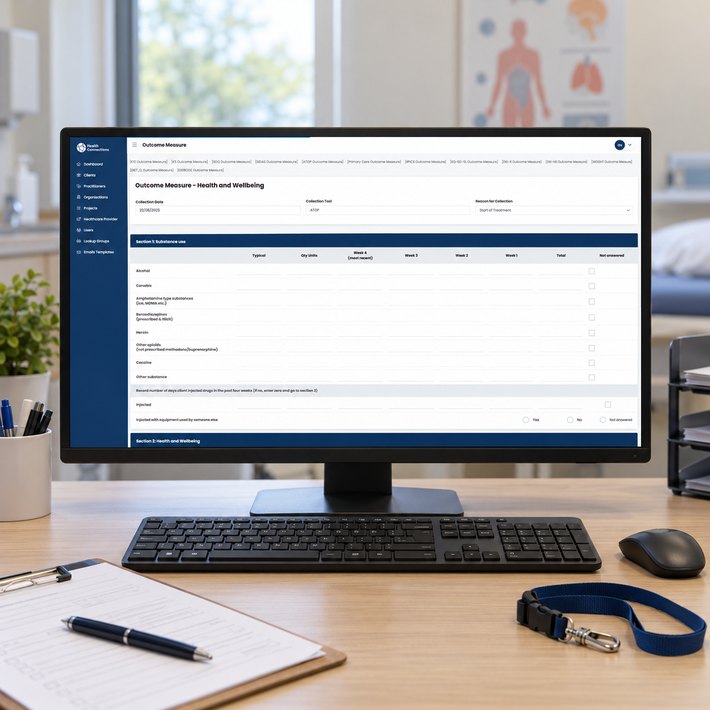
Clinical outcome tools

K10+, K5, SDQ, SIDAS and ATOP collected against the episode, with the collection date and reason for collection recorded each time.

05

Intake and referral

Intakes capture the referral, referring organisation and outcome, with the IAR-DST decision support tool completed on the way in.

06

Automated SLK and de-identification

Statistical Linkage Keys generated from client details automatically, with consent to anonymised data recorded and records de-identified on request.

Country SA PHN PMHC episode of care screen on a monitor in a community mental health consulting room
Episodes of care

Every episode captured the way the Minimum Data Set expects

Reporting to the national MDS depends on every service recording the same things in the same structure. We modelled the PMHC and AOD episodes of care directly on the data set, so a practitioner enters the episode once and the record is already in the shape the PHN has to report. Service contacts and outcome measures hang off the same episode.

  • PMHC and AOD episode types built on the MDS specification
  • Diagnosis, program type and cessation reason per episode
  • Service contacts recorded against the episode
  • Open, closed and stale episodes counted on the dashboard
Clinical tools

Outcome measures recorded at the desk, not transcribed later

Clinical outcome tools were being completed on paper and typed up afterwards, or not at all. The portal carries the K10+, K5, SDQ, SIDAS and ATOP instruments as forms against the episode, so the clinician records the collection date, the reason for collection and the scores in the one place, and the measure is reportable the moment it is saved.

  • K10+, K5, SDQ, SIDAS and ATOP built in
  • Collection date and reason recorded with every measure
  • Measures listed against the episode they belong to
  • Scores reportable without re-keying
Country SA PHN ATOP outcome measure form on a clinician's monitor at an alcohol and other drugs service
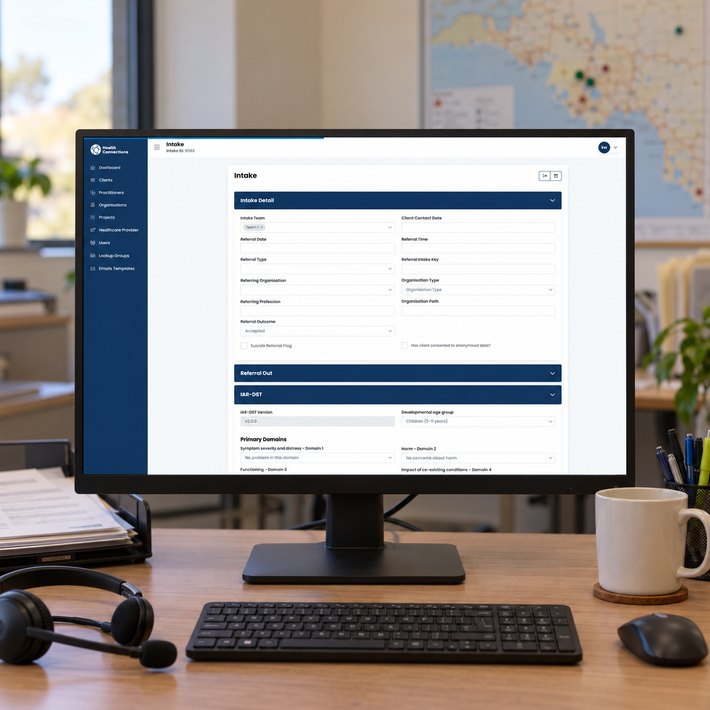
Country SA PHN intake screen on an intake officer's monitor in a regional health office
Intake and identity

One client record, a linkage key generated for them automatically

The MDS identifies clients by a Statistical Linkage Key rather than a name, and generating it by hand is error prone. Clients are recorded once with the demographic fields the data set requires, the SLK is generated from those details automatically, and intakes capture the referral, its outcome and the IAR-DST assessment. Consent to anonymised data is recorded, and a record can be de-identified when it needs to be.

  • Client key and SLK generated automatically
  • Intake with referral details, outcome and IAR-DST
  • Consent to anonymised data recorded on intake
  • De-identify a record in one action
Providers

Each service works in its own space, the PHN reports across all of them

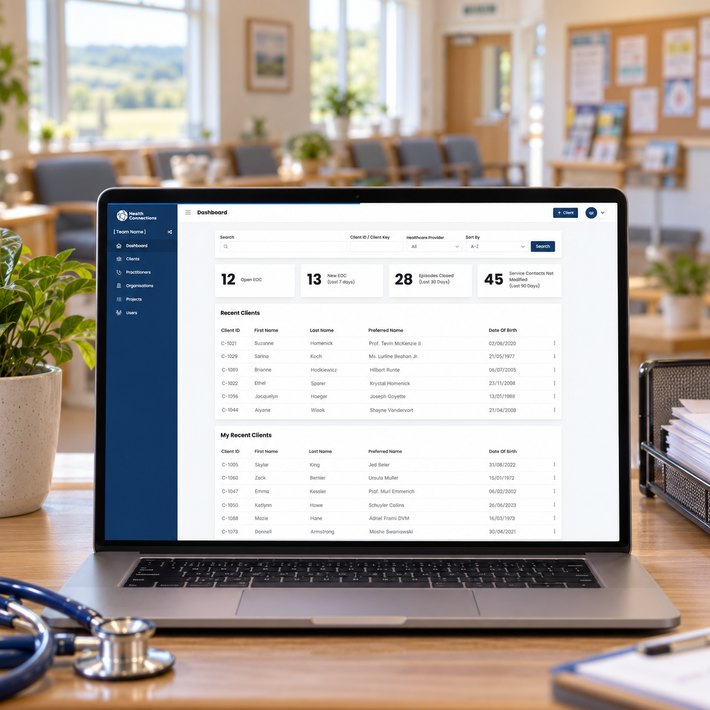
A single shared database would have meant every provider seeing every client. Instead each healthcare provider has its own tenant with its own teams, practitioners and client list, and sees only its own work. PHN staff administer organisations, projects and lookup data centrally and see the whole picture, so the reporting that used to be assembled from returns comes straight out of the portal.

  • Provider tenants with their own teams and practitioners
  • PHN-wide view for commissioning and reporting
  • Organisations, projects and lookup groups managed centrally
  • Client search by ID, key or provider across the network
Country SA PHN provider dashboard on a laptop at a country medical practice front desk
Technology stack

How it's built

The portal is a multi-tenant web application built around the PMHC and AOD Minimum Data Set specifications, with clients, intakes, episodes of care, service contacts and outcome measures as first-class records, automated Statistical Linkage Key generation, de-identification and configurable lookup data. It is the first stage of a wider platform for the PHN.

Single page application

Built in Vue.js as a single page application, for a fast experience without page reloads and the flexibility to evolve as the system grows.

API-focused backend

The backend is built in Laravel and MySQL with an API-first interface, so the web and mobile apps share the same endpoints.

Continuous integration

Automated testing and deployment let us test new builds and update production quickly, so we can release as often as required.

Managed hosting

Amazon's Elastic Container Service runs each service in its own container within a cluster that scales up and down as needed.

Managed hosting

Reporting clinical data to a national data set?

A portal that captures the data in the right shape at the point of care, for every provider, takes the assembly work out of compliance reporting. Tell us what your services have to report.

Get in touch More of our work
Back to our work Next case study: Big Screen Video
Codium Logo
Codium Pty Ltd.
Ground Floor, 207 Greenhill Road
Eastwood, 5063
Adelaide, South Australia
  • 1300 887 103
  • sales@codium.com.au

Development

  • Software Development
  • Mobile Apps
  • Software Integration
  • Hardware Integration
  • Microsoft Access
  • Replace Spreadsheets

Managed Services

  • Software Takeover
  • Software Support (SLA)
  • Managed Hosting
  • Private AI Hosting
  • On-Premise AI

AI

  • AI for Business
  • AI Reporting

Strategy

  • Technology Partner
  • UI / UX Design
  • Due Diligence (M&A)
  • Why Projects Succeed
  • What Software Costs

Technologies

  • PHP · Laravel
  • JavaScript · Vue.js
  • AWS

Company

  • About Us
  • Industries
  • Our Work
  • Blog
  • Careers
  • Contact Us
  • Customer Feedback
  • Remote Support

© Codium Pty Ltd. All Rights Reserved.

  • Terms of Business
  • Privacy Policy
  • Quality Policy
  • Security Policy
  • Customer Experience Charter
Back Top
Codium
Services
All services Strategy
  • Technology Partner
  • UI / UX Design
  • Technology Due Diligence
  • Why Projects Succeed
  • What Software Costs
Development
  • Software Development
  • Mobile App Development
  • Software Integration
  • Hardware Integration
  • Microsoft Access Databases
  • Replace Spreadsheets
Managed services
  • Software Takeover
  • Software Support (SLA)
  • Managed Hosting
  • Private AI Hosting
  • On-Premise AI
AI
  • AI for Business
  • AI Reporting
Industries
All industries
  • Construction
  • Finance
  • Government
  • Health
  • Insurance
  • Manufacturing
  • Mining
  • Retail & E-commerce
  • Transport & Logistics
Our Work About Blog
Get in touch Call 1300 887 103